
2026 Geely EX2 Review

From relative obscurity just five years ago, five Chinese brands featured in the 11 most popular makes in Australia for the month of July. It comes as new research from the Australian Automotive Dealer Association predicts Chinese-made vehicles will make up 60 per cent of all new car sales in Australia by 2035.
Why? The new Geely EX2 is a glowing case in point. It lands in Australia this month as the most popular new car in its home nation, and the second most-affordable EV available in Oz. But unlike earlier Chinese vehicles, there’s more substance to the EX2 than an appealing sticker price.
Backed by the same parent company that owns Volvo, Zeekr and Polestar, among others, Geely is now gearing up to launch six new models in the next 12 months.
This is no dress rehearsal, even if the EX2 has a few rough edges.
How much does the 2026 Geely EX2 cost?
The Geely EX2 range opens at $26,490 (plus on-road costs) for the entry Complete specification, climbing to $30,990 (plus on-road costs) for the flagship Inspire.
At that price the EX2 is officially the cheapest five-seat electric vehicle available in Australia and only undercut overall by the four-seat BYD Atto 1 (from $23,990 plus ORCs).
Unsurprisingly at that price the Atto 1 is a key competitor, as is the BYD Dolphin (from $29,990 plus ORCs), MG4 Urban (from $31,990 drive away), Leapmotor B05 ($35,990 drive away) and the upcoming Honda Super-One ($36,900 drive away).
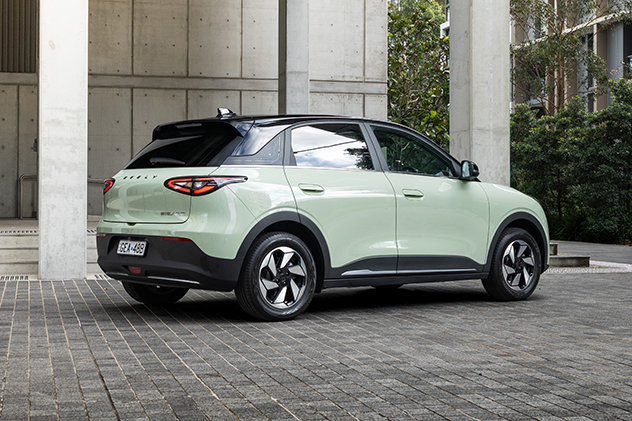
The EX2 forms the entry point to Geely’s Australian operations for now. In due course, the brand will offer additional hybrid models to complement its EV onslaught. Watch this space.
What is the 2026 Geely EX2 like inside?
Considered.
Like any hatchback premised around a competitive price, the Geely EX2 does take a couple of shortcuts in order to achieve the brief, with mostly hard-wearing plastics at the contact points, no spare wheel, and some quirks, including the absence of up/down adjustment on the front passenger seat.
The doors don’t ‘thunk’ shut with the same authority as a European equivalent, and we noticed some ever-so-slight panel inconsistencies upon close inspection outside. But you take the good with the bad here – and there is plenty of good.
By and large, the EX2 has all the bones of a solid runabout, with excellent proportions that bely its 4.3-metre length, and a plethora of storage options across both rows of seating.
Geely counts more than 20 different storage options across both rows, including a cool draw-like glovebox which offers a heap of space hidden from public view. There are USB-A and USB-C ports up front too.
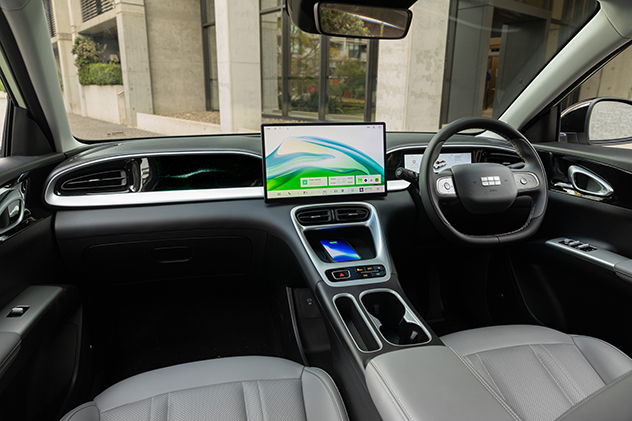
Infotainment is a potential bone of contention. Like many new EVs, the 14.6-inch centre touchscreen is the nerve centre of the entire car, with a general lack of buttons and switchgear to access its myriad functions.
The workaround from Geely is some permanent icons at the base of the screen which offer quick access to functions, but we’d still prefer the feel and convenience of actual buttons.
Otherwise, the front seats are comfortable and offered decent support across our circa 200km driving journey.
Entry to the rear seat is via a relatively tight door aperture. Once you’re in, however, the second-row space offers adequate proportions for a couple of full-size adults, with the open glasshouse design also well-suited to smaller passengers. Rear seaters don’t have access to a flip down arm rest, although there were rear air vents and a rear power source on the flagship models we drove at launch.
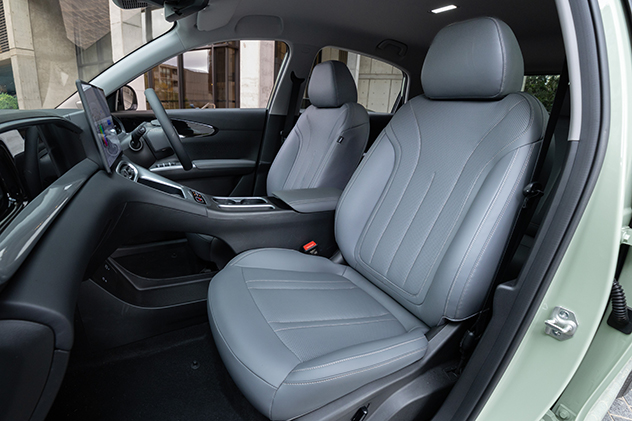
The spatial layout is complemented by a healthy 70-litre frunk up front and a 375-litre boot area. There is no spare tyre, but you do get a powered tailgate on the flagship model, as well as handy levers to stow the second-row pews.
What equipment does the 2026 Geely EX2 come with?
There are some obvious materials cues that point to the EX2’s sticker price, but it gives away very little in the way of equipment.Standard kit in the entry car includes 16-inch steel wheels, LED headlights, power-adjustable front seats, rear parking sensors and a reversing camera. Meanwhile, infotainment is taken care of by the aforementioned 14.6-inch touchscreen, 8.8-inch instrument display, and four-speaker audio system.
Along with a more powerful drivetrain, the Inspire grade gets 16-inch alloy wheels, a powered tailgate, ambient lighting, heated front seats, rain-sensing wipers, a heated steering wheel and wireless phone charging. Audio is up upgraded to a six-speaker system, while a 360-degree camera adds better visibility in tight parking situations.
The EX2 is backed by a seven-year/unlimited kilometre warranty in Australia, while its battery gets a separate eight-year/unlimited kilometre fixture.
Servicing intervals are set at every 12 months or 20,000km, whichever comes first. Pre-paid scheduled servicing packages are set at $517 for three years, $1190 for five years and $1642 for seven years.
Roadside assistance is offered for up to seven years when you service through an authorised Geely service centre.
How safe is the 2026 Geely EX2?
The Geely EX2 hatch gets seven airbags and the usual electronic driver aids.There’s also autonomous emergency braking, front and rear cross-traffic alert, assisted lane changes on motorways, blind spot monitoring and driver fatigue alert. A reversing camera and rear parking sensors are standard across all grades.
The EX2 is yet to be formally crash-tested by ANCAP, but Geely officials are confident it will achieve a five-star score.
Sadly, that testing won’t likely take into account the onerous nature in which many of the EX2’s safety features intervene, with the usual beeping and bonging that has become commonplace in new cars.
Geely points out there is a shortcut button to turn it off – which kind of defeats the purpose of having the safety systems to begin with. What’s more, you’ll need to turn it off each and every time you enter the car.
What powers the 2026 Geely EX2?
The base spec Complete is powered by a 60kW/150Nm electric motor which draws power from a 35.3kWh lithium-iron-phosphate (LFP) battery pack. Range is set at 252km (WLTP test standards), while DC charging is rated up 60kW, and AC home charging at 6kW.The flagship Inspire trim brings a more powerful 85kW/150Nm rear motor together with a 47.1kWh LFP battery for an extended 345km of range. AC charging remains capped at 6kW, while DC capacity is increased to 80kW.
The entire EX2 line-up is underpinned by independent rear suspension, helping ensure a more sophisticated ride and handling package. Geely cites nine international locations where it did testing and development, though concedes there was no work done in Australia.
What is the 2026 Geely EX2 like to drive?
The Geely EX2 is remarkably clinical and sound in what it does on-road.
The entire car feels very approachable, endearing itself to drivers whose regular commutes take in stop-start traffic, narrow streets and underground carparks. By the same token, it is also surprisingly adept in touring situations, where its independent rear suspension and strong roadholding endow it with confidence and poise.
The steering is light in the hands at low speed, and the EX2 feels predictable in the way it tackles speed humps, pitter-patter undulations and intersections, with minimal thudding or crashing. Outward vision is also strong.
Acceleration is progressive rather than all-out zippy – and that’s in the more powerful flagship (0-100km/h in a claimed 11.5 seconds), not the slower entry car (0-100km/h in 14.2 seconds) which is slower again. There’s not enough grunt to spin the rear tyres, for example, but once rolling the acceleration on offer is ample for a runabout.
There’s an argument to say the EX2 lacks the character and soul of a traditional cheap runabout, with steering that feels inert and lacks weighting, and occasions where it reveals its full 1400kg kerb weight.
Our first drive didn’t take on any extended sections of highway speed.
If it did, our big point of focus would be battery life. Even with frugal city running we weren’t able to replicate Geely’s 345km claim for the flagship. With 70 per cent battery remaining, the EX2 predicted a 204km electric range. That equates to a real-world figure closer to 290km.
Open Road’s take on the 2026 Geely EX2
The Geely EX2 is extremely proficient as a small city car. That it completes the brief as an electric car, with a full suite of equipment and technology, makes a compelling argument.The Chinese car boom is well and truly here, and legacy car brands are officially on notice.
What we liked
- Impressive spatial layout and storage for a ‘light’ car
- Strong standard equipment list and aftersales credentials
- Feels well rounded on-road, and approachable as a commuter car
What could be better?
- Onerous safety systems that distract from driving
- No spare tyre of any kind; occasional interior shortcut
- The 345km top-spec EV range appears optimistic


