Road rules when passing and giving way to emergency vehicles
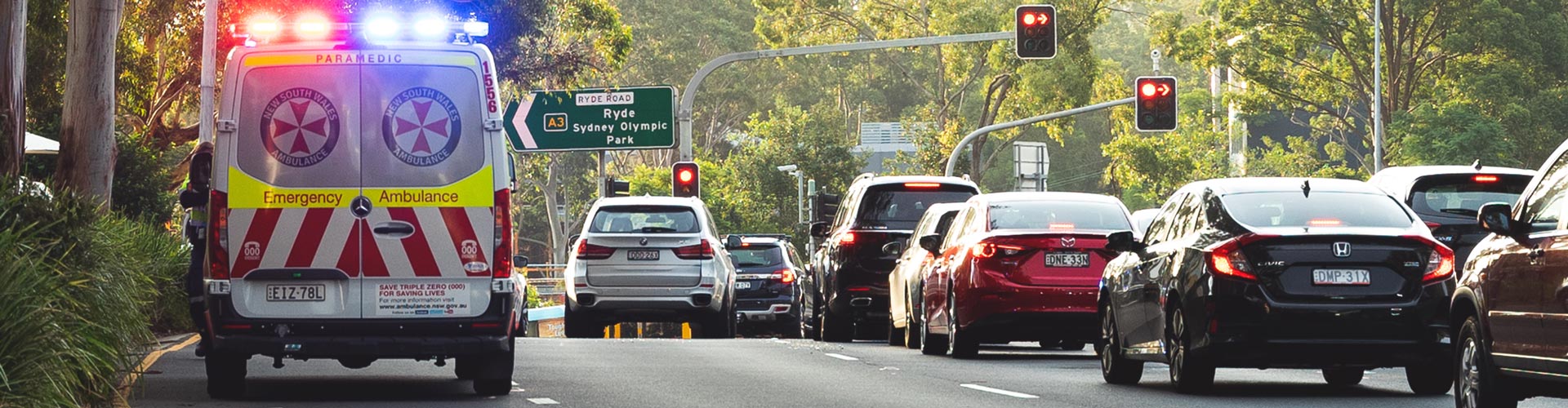
On 1st September 2018, New South Wales (NSW) introduced a road rule requiring drivers and riders to reduce their speed to 40km/h when passing stationary emergency vehicles displaying flashing blue, red, or amber lights.
What to do when passing a stationary emergency vehicle with flashing lights
- Where the speed limit is 80 km/h or below: Drivers are required to slow down to 40 km/h when passing stationary emergency response vehicles with flashing lights.
- In speed zones above 80 km/h: Drivers must slow to a safe and reasonable speed, considering the circumstances. If it’s safe to do so, drivers should change lanes to give more space.
- In both instances, drivers may need to change lanes, if safe to do so, to allow more space when passing a stationary vehicle with flashing lights.
A penalty notice fine of $544 and 3 demerit points applies for motorists who increase their speed when passing or fail to slow down to 40km/h when the posted speed limit is 80km/h or below.
Keep in mind the rule does not apply when the stationary emergency vehicle is on the opposite side of a divided road separated by a median strip.
What type of vehicles are covered by this rule?
Drivers must obey the rule when passing the following vehicles when stationary and displaying flashing blue, red, or amber lights:
- NSW Police Force vehicles
- Ambulance Service of NSW vehicles
- Fire & Rescue NSW vehicles
- State Emergency Service vehicles
- Rural Fire Service vehicles
- Volunteer Rescue Association vehicles
- Transport Emergency Patrol vehicles
- Traffic Commander vehicles
- Tow trucks
- Breakdown assistance vehicles
What are the basic rules around emergency vehicles and giving way?
Starting from the top with the Australian Federal Police or AFP, the official line is to move as far to the left of the road as you can, coming to a stop.
Before doing so, the advice is to check your mirrors and blind spots, use your indicator and be aware of the traffic or road users around you. Additionally, don’t make any manoeuvres that will potentially damage your vehicle or others in a bid to give way.
If the emergency is a couple of lanes over, the same rules apply. Be aware than motorists in the adjacent lane may want to move into your lane in a bid to give way to the emergency vehicle. There are instructions in place if you can’t physically get out of the way, too: “Stay where you are and let the emergency vehicle drive around you,” says the AFP. This could be because of a pedestrian, cyclist or car impeding your attempt to move over.
Some states in Australia will overlook some minor driving misdemeanours if a motorist is making way for an emergency vehicle, but the general advice is to avoid this unless completely necessary, and only do so when it is safe.
Which states enforce lower speed limits around emergency vehicles with their lights and sirens on?
This is where the rules around emergency vehicles can begin to become confusing, especially if you’re an Australian resident travelling interstate. There are several different rules in place across the country.
In Victoria and Tasmania, motorists are asked to slow to 40km/h when passing emergency vehicles, escort vehicles or enforcement of any kind on the side of a freeway or highway – but only when those vehicles are stopped with lights and/or sirens on, or travelling at 10km/h or slower with lights and/or sirens on.
The same rule doesn’t apply when the vehicle is on the opposite side of a divided road, as in one separated by a median strip or dividing barrier.
When can you speed back up? According to Victorian law, when you are a “safe distance from the scene”.
Western Australia stipulates drivers in all lanes slow to 40km/h when approaching stationary emergency vehicles, while South Australia mandates an even slower speed limit of 25km/h when motorists are within close proximity of an emergency vehicle. Both states say the laws do not apply to emergency vehicles on the other side of a median strip.
In NSW and the ACT, the lines become a little more blurred. Here, the rule is to slow to 40km/h when passing stationary emergency vehicles with flashing blue or red lights – but only when the road features a posted speed limited of 90km/h or less. On roads with a posted speed limit above 90km/h, the rule is to slow to a speed that is “reasonable” for the circumstances.
Queensland and the Northern Territory are more ambiguous with their rules, advising motorists to change lanes and slow down if possible to do so.
It’s worth noting the rules whenever travelling interstate; failure to obey respective laws can result in fines exceeding $900, depending on the state or territory you’re in.
What's the history of this law?
On 1st September 2018, NSW trialled a road rule requiring drivers and riders to reduce their speed to 40km/h when passing stationary emergency vehicles displaying flashing blue, red, or amber lights.
The new rule referred to as Sarah’s Rule, was born out of tragedy when Sarah Frazer tragically lost her life in 2012 when she was struck on the roadside after her car broke down on the Hume Highway. Sadly, the tow truck driver who had come to help also lost his life. The Safer Australian Roads and Highways (SARAH) Group was established in her memory.
Upon completing a review of the trial including feedback from the NRMA, SARAH Group and community feedback, the road rule was amended to extend to roadside assistance vehicles, including tow trucks. Changes were also made to the speed motorists needed to slow down to on higher-speed roads due to the time and distance required to slow down to 40km/h.
Similar legislation is already in effect in other Australian states and territories, including Western Australia, Victoria, South Australia and the ACT. These measures reflect a growing national consensus around protecting people working or near the roadside. Other countries also have similar road rules.